Persona in Paid ads
Before an ad gets made, someone has to understand who they're talking to. This is the strategic framework I built for 28's campaigns. It maps real-life triggers, emotional states and desires to find the angle that actually lands with cold traffic.
The problem
Cold traffic doesn't respond to generic fitness ads because people don't see themselves in them
The approach
Instead of targeting only on demographics, our team built scenarios around real-life moments and emotional states.
I then developed the creative direction and its iteration on these personas.
The question isn't "who is she?" but "what just happened that made her stop scrolling?”
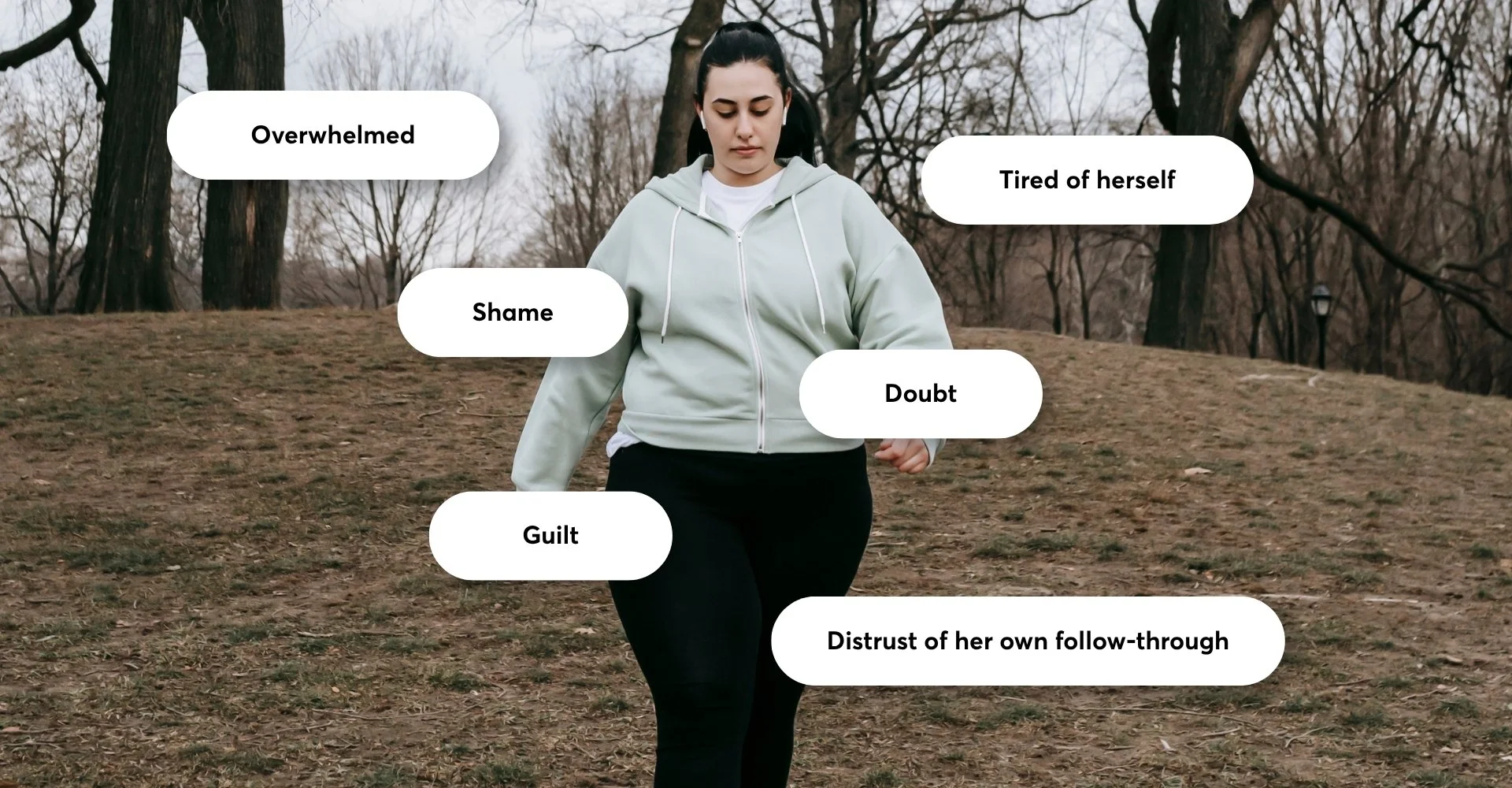
A case study
Meet Laura, 38, Brisbane
Mum, juggling family and work, with a long history of starting strong and stalling.
The life trigger:
She sees a number (on the scale, mirror, a clothing size) and does the maths on how far she is from where she wants to be. The gap feels so big that the idea of closing it stops feeling like a goal and starts feeling like a joke she tells herself.
Where they're at emotionally:
She's lost faith in her own follow-through, and the size of the goal makes every plan feel pointless before she's begun. She needs to believe it's possible.
What they actually want:
For the goal to stop feeling impossible. She wants a first step small enough to take today, meals the whole family will actually eat, and people on her side who don't make her feel judged for where she's starting.
The ad angle that came from it:
"One decision. One step, Each week."
The ad names the size of the goal, then shrinks it.
“You don't need to lose 50kg today, you just need to start.”
Leads with empathy for the years of stop-start, then offers simple workouts, family-friendly meals and real support.
The output
Main ad
Idea: Why a podcast-style format?
Many experts share their knowledge through podcast interviews.
We haven’t tried this style before, so I thought it would be an interesting format to test.
Script:
When your goal is big… 30, 40, 50 kilos…
the problem isn’t motivation. It’s that the finish line feels so far away
you don’t know where to start. That’s why we created the 8 Week Challenge. Not to make you think about the whole journey, but to help you start with small goals.
One workout. One meal. One day at a time.
You get a clear plan for what to do, Short workouts at home, Simple meals that fit real life, A team to keep you accountable, And a community who started where you are.
You’re not trying to lose 50 kilos today. You’re just committing to yourself one day at a time. Big goals stop feeling overwhelming when you start with day one of the 8 Week Challenge.
Spend
A$33,366.04
Purchases
182
CPA
A$183.33
CTR (outbound)
1.28%
Iteration ads

Idea: Why a twitter-style format?
Again, many experts share their knowledge through twitter screenshots, reposts and reupload through their social media.
We haven’t tried this style before, so I thought it would be another interesting format to test.
Spend
A$19,355
Purchases
189
CPA
A$102.41
CTR (outbound)
0.76%
Piece to camera iterations in different formats (green screen, catchy hook, selfie video)
Total Spend
A$52,238.27
Purchases
370
Avg CPA
A$134.78
Other formats


Total Spend
A$13,570
Purchases
122
Avg CPA
A$127.2
What I learned
Starting from a person rather than a demographic gave us one idea that worked across formats. The same persona, "the goal feels impossible, so make the first step small," carried through a podcast-style interview, a Twitter-style screenshot and several pieces to camera. Across the persona-led ads, that came to A$52K spend, 370 purchases and a A$134.78 average CPA.
The format changed the cost far more than the message did. The podcast-style ad earned the higher click-through rate (1.28%), but the Twitter-style iteration converted more cheaply (A$102.41 CPA vs A$183.33) even with a lower CTR (0.76%). The persona got people to stop and recognise themselves, and the format decided how efficiently that attention turned into purchases.
What I'd take forward:
Write the persona before the concept, and the concept before the format.
Produce several main scripts and keep iterating on the performing ones.
Test the same insight in several formats rather than betting on one.
Don't optimise for clicks alone. The ad that got fewer clicks was the cheaper one to buy from.